
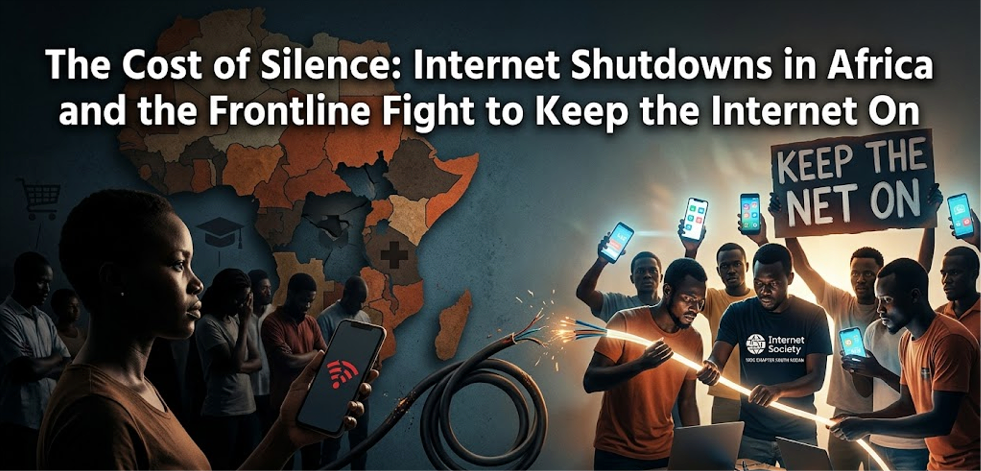
When the government of South Sudan ordered Internet service providers (ISPs) to block access to major social media sites, a 90-day countdown on public communication began. For a country where millions rely on these platforms for news, survival, and business, the blackout was a looming economic and social disaster.
Joseph Gama, the president of the Internet Society (ISOC) South Sudan chapter, refused to let the clock run down.
Within hours of the directive, Gama and his chapter mobilized a rapid response. They drafted an urgent appeal to parliament and immediately connected with local journalists to amplify the issue across national airwaves. The advocacy was so precise, and the public pushback so swift, that the government capitulated just five days later. When the state lifted the shutdown, its public announcement echoed the exact terminology and arguments laid out in the Internet Society’s letter.
A Digital Epidemic: The African & Global Landscape
South Sudan’s victory is an inspiring exception in what has otherwise become a grim global trend. Digital blackouts—ranging from total network kills to targeted social media throttling—are increasingly used by governments as tools for political control, narrative policing, and information suppression.
The scale of the problem remains staggering:
- The Recent Toll: Globally, there have been 94 recorded shutdowns across 14 countries since December 2024.
- The Silver Lining: While 94 shutdowns are still 94 too many, the data reveals a trajectory of progress. At this exact time last year, the number of tracked shutdowns sat at 136.
The contraction in these numbers is not an accident of politics; it is the direct result of relentless, coordinated resistance by digital rights advocates, local chapters, and everyday citizens who refuse to be muted.
                GLOBAL SHUTDOWNS (YEAR-OVER-YEAR COMPARISON)

  Last Year     █████████████████████████████████████████████ 136

  This Year     ███████████████████████████████ 94
The High Cost of Cutting the Cord
When a state pulls the plug on the internet, the damage extends far beyond silenced political dissent. In modern African economies, internet access is basic infrastructure—tied directly to financial survival, healthcare, and education.
| Impact Area | Real-World Consequence |
| Economic Devastation | Disrupts mobile banking, stalls time-sensitive transactions, and freezes supply chains. Small businesses and gig workers suffer instant revenue drops. |
| Humanitarian Crises | Isolates citizens during times of instability, cutting off lines of communication to family, emergency medical services, and safety alerts. |
| Loss of Transparency | Creates an information vacuum, allowing human rights violations to occur behind a curtain of digital darkness. |
The Role of the Internet Society
The Internet Society (ISOC) stands as a vital shield against this digital overreach. Through its network of localized chapters across Africa and the world, ISOC intercepts shutdowns using a multi-pronged approach:
- Rapid Local Mobilization: As seen in South Sudan, local chapters understand the immediate political and cultural landscape, allowing them to lobby policymakers within hours of a disruption.
- Public Awareness & Media Partnerships: By equipping journalists with data, ISOC ensures that internet shutdowns remain front-page news, raising the political cost for regimes attempting to hide their actions.
- Tracking & Accountability: Keeping meticulous, data-driven records of shutdowns allows global coalitions to hold offending nations accountable in international policy forums and courts.
Join the Fight to Keep the Internet On
The drop from 136 to 94 shutdowns proves that pushback works. Tyranny thrives in silence, but when technical communities, activists, and citizens unite, governments are forced to listen.
However, the battle is far from over. As long as any state retains the unchecked power to sever its citizens from the global community, the open internet remains under threat.
We need your voice, your advocacy, and your support to continue pushing back against digital blackouts. Help us fight against Internet shutdowns and ensure that no one, anywhere, is ever shut out or left behind.
About Author


More Stories
Bridging the Digital Divide: Nigeria’s First Community-Centred Connectivity Bootcamp Kicks Off in Abuja.
Safeguarding the Digital Future: Turning Challenges into Momentum for Africa’s Encryption Infrastructure.
NVIDIA Unveils DLSS 5 and Cosmos Physical AI Platform at SIGGRAPH Keynote.