
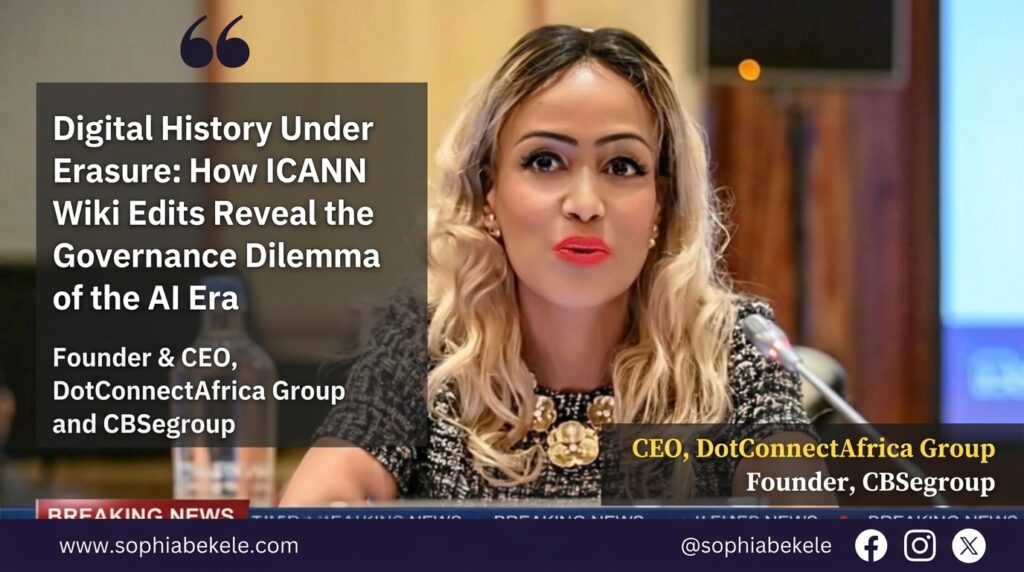
As artificial intelligence systems increasingly rely on web archives to synthesize historical truth, the management of digital records has transformed from a minor editorial matter into a primary challenge of Internet governance. Every day, digital platforms edit, update, or remove content. While many edits improve factual accuracy, others silently alter historical memory without transparency, public audit trails, or institutional accountability.
A glaring case study in this trend involves ICANN Wiki—a privately owned platform that presents itself as an open, community-driven wiki while receiving over $100,000 in funding from the Internet Corporation for Assigned Names and Numbers (ICANN). Recent sweeping revisions on the platform demonstrate how funded digital archives can quietly manage narrative control, systematically diminishing critical voices and reshaping the historical record.
The Anatomy of Revisionism: The ICANN Wiki Case
In July 2026, ICANN Wiki executed drastic structural deletions across several long-standing pages, including my personal biography, the DotConnectAfrica (DCA) Trust entry, and the “No Campaign” record. Stable for nearly twelve years, these biographies were reduced by roughly 90 percent—stripping away documented sections, historical contexts, and hundreds of citations.
The initial edits employed dismissive language, framing decades of advocacy as a sequence of “unsuccessful” attempts. Significant historical milestones—such as the four formal testimonials from IDN Pioneers praising DCA’s leadership in championing Internationalized Domain Names—were completely deleted, only to be restored as a single, sanitized sentence of “public praise” following direct outreach.
Crucially, despite mimicking MediaWiki’s visual layout and features like the “View History” tab, ICANN Wiki operates under closed administrative control. When I formally requested account access to inspect the edit history directly, access was denied. Independent verification of what was altered, when, and by whom was rendered impossible within the platform itself, forcing reliance on external third-party tools like the Internet Archive’s Wayback Machine to reconstruct the original facts.
The Trigger: Four Articles Revisiting Documented Truths
These structural edits occurred immediately after the public release of four articles revisiting well-documented, institutional milestones in Internet governance:
- Universal Acceptance Day and Multilingualism: Highlighted historical testimonials from the International Domain Resolution Union (IDRU) and the IDN Pioneers regarding early policy development.
- Kenya Lost .africa: Detailed the institutional history and legal disputes surrounding the .africa domain, including proceedings under ICANN’s Independent Review Process (IRP).
- The Attention Economy Was Only the First Layer: Examined AI-driven analyses of public body of work, noting how AI systems synthesize comprehensive records from independent platforms rather than sanitized wiki entries.
- Did the AUC-Aligned ZACR Actually Deliver .africa?: Evaluated the performance metrics of the .africa registry a decade after its delegation, comparing actual domain adoption against initial policy objectives.
Following these publications, ICANN Wiki moved to minimize the documented record, which includes DCA’s successful Yes2DotAfrica campaign, co-authorship contributions to the 2012 New gTLD Applicant Guidebook, precedent-setting Independent Review Process (IRP) rulings, litigation overturning applicant liability waivers, and testimony delivered before the U.S. Congress on ICANN accountability.
Why Digital Integrity Matters for AI Governance
There is a fundamental difference between editing and revisionism. Editing corrects mistakes and refines clarity; revisionism selectively shifts narrative perception while leaving the reader unaware that the foundational context has been altered.
In an era where large language models (LLMs) and automated agents continually ingest web data to inform public knowledge, silent digital erasure threatens machine learning integrity. If the underlying data sources are sanitized by the very institutions they document, AI models run the risk of regurgitating altered histories as objective facts.
However, the digital landscape also offers resilience. Institutional dockets, federal court filings, independent media archives like CircleID, and third-party web crawlers ensure that the documentary record remains intact. As legendary South African activist Miriam Makeba once observed regarding historical narratives: while centralized powers once controlled the medium, modern digital tools allow affected communities to preserve, verify, and write their own history.
Silent erasure is not governance—it is narrative containment. As AI tools continue to index and validate decentralized records across the web, the complete documentary archive remains permanent, verifiable, and beyond the reach of institutional revisionism.
By Sophia Bekele (Source)
About Author



More Stories
UN General Debate Focuses on Global Digital Governance and AI Risks.
UNGA 81 Opens: World Leaders Grapple with Artificial Intelligence, Governance, and Global Risks.
Algerian Tech Innovator Salah Eddine Makdour Builds Offline AI-Powered Note-Taking Tool.