
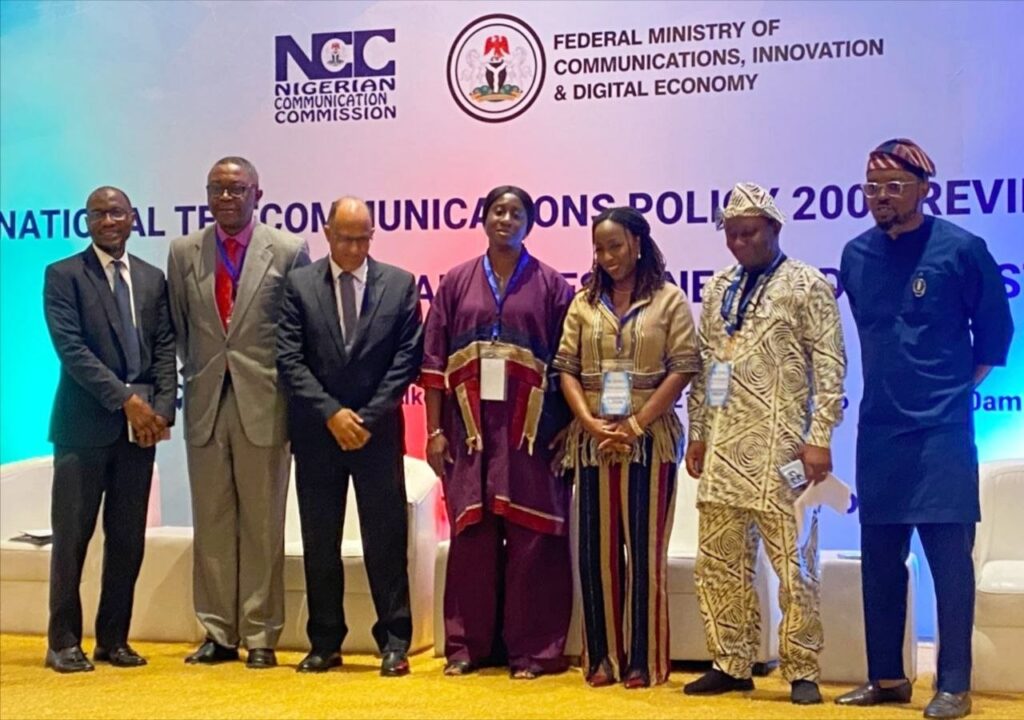
LAGOS, NIGERIA — As the federal government intensifies its drive to transition Nigeria into a resilient, fifth-generation digital economy, civil society and technical advocacy groups have stepped up to ensure that the evolving policy landscape remains people-centered, inclusive, and culturally sovereign.
At the recently concluded Two-Day National Telecommunications Policy (NTP) Review Workshop hosted by the Nigerian Communications Commission (NCC) in Lagos, the Internet Society (ISOC) Nigeria Chapter delivered a powerful stakeholder presentation aimed at bridging the gap between global technical infrastructure and local community impact.
Bringing the Grassroots to the Policy Table
Representing the Chapter President, Engr. Kunle Olorundare, the Vice President of the ISOC Nigeria Chapter, Dr. Adebunmi Adeola Akinbo, delivered the society’s official position during the strategic sessions. Dr. Akinbo—a seasoned internet governance expert and the ICANN At-Large Advisory Committee (ALAC) Representative for Africa—reiterated that while upgrading Nigeria’s 26-year-old framework to accommodate 5G, satellite technology, and advanced broadband penetration is highly commendable, the true test of the NTP 2026 lies in its local implementation.
“A truly open, secure, and globally connected internet must first make sense to the local user,” Dr. Akinbo stated, delivering Engr. Olorundare’s message to the regulatory assembly. “As we review this historic framework, our focus must expand beyond basic infrastructure layout to encompass deep digital inclusion, local content development, and linguistic sovereignty.”
Core Pillars of the ISOC Nigeria Presentation
The ISOC Nigeria presentation outlined a clear roadmap for the NCC and collaborating agencies, emphasizing three critical areas:
- Universal Acceptance (UA) & Linguistic Sovereignty:
Dr. Akinbo strongly advocated for the technical integration of indigenous languages into Nigeria’s digital systems. For the internet to be genuinely inclusive for millions of citizens in rural and underserved areas, digital systems and domain names must natively support local scripts and languages. - Infrastructure Protection via Community Networks:
Addressing the review’s focus on protecting Critical National Information Infrastructure, the presentation highlighted how empowering local communities to co-own digital infrastructure reduces vandalism and lowers operating expenses for the entire ecosystem. - Online Trust, Safety, and AI:
Building on the Chapter’s ongoing 2026 missions—including its massive nationwide campaign that trained over 2,500 Nigerians for Safer Internet Day—ISOC Nigeria called for the new NTP framework to establish robust, ethical guardrails for Artificial Intelligence (AI) and cyber hygiene that safeguard vulnerable demographics, including youth and rural communities.
A Collaborative Future
The presentation concluded with a strong call for multi-stakeholder collaboration. ISOC Nigeria stressed that the ambitious macroeconomic goals of the NTP 2026—such as boosting the national GDP and generating jobs—can only be actualized if the NCC, civil society, and technical communities work hand-in-hand to build an open, trusted internet for every Nigerian, regardless of location or economic status.
By aligning global technical standards with local culture and community-centered connectivity, the ISOC Nigeria Chapter continues to ensure that Nigeria’s journey into the digital future leaves no citizen behind.
About Author




More Stories
ICANN Announces DNSSEC Root Zone Key Rollover for October 2026: What Network Operators Need to Know.
Countdown to AIS’26: Tech Leaders and Innovators to Convene in Nairobi for Africa Internet Summit.
African Internet Governance Gains Momentum as ICANN86 Reviews Regional Progress and FY27 Priorities.