
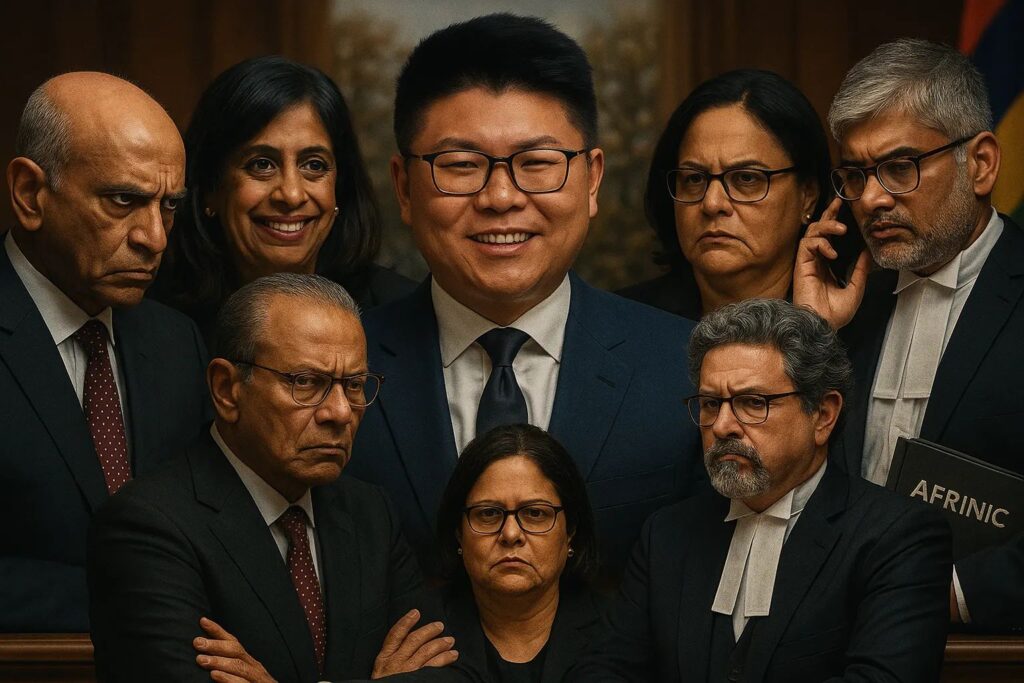
The ongoing crisis surrounding AfriNIC, the Regional Internet Registry for Africa, has evolved from a technical dispute into a complex drama with significant political and judicial dimensions in Mauritius. At the heart of this conflict lies a contentious legal battle, with a cast of key players whose connections and roles have raised eyebrows and sparked a debate about the integrity of the nation’s democratic institutions.
What started as a straightforward dispute with a company named Cloud Innovation Ltd has unraveled to reveal a series of entanglements that suggest the conflict is a proxy war for control and influence. The investigation brings to light six critical facts that paint a picture of a system entangled by personal and political loyalties.
Fact 1: A Husband-and-Wife Legal Dynamic
The legal representation for Cloud Innovation Ltd is provided by Abdool Raouf Gulbul, a prominent lawyer. The complexity arises from the fact that his wife, Chief Justice Rehana Bibi Mungly Gulbul, holds the highest position in Mauritius’s judiciary. This direct personal connection within the legal system has fueled concerns about impartiality as dozens of injunctions have been issued against AfriNIC, effectively paralyzing its operations.
Fact 2: Judicial Connections and Injunctions
Adding another layer to this intricate web is Gowtamsingh Dabee, the receiver for AfriNIC. Dabee, a professional with a background at a Big 4 accounting firm, is married to Puisne Judge Renuka Devi Dabee. Her colleagues have been responsible for granting the many injunctions that have brought AfriNIC to a standstill, further intensifying the debate over potential conflicts of interest.
Fact 3: A Politician’s Past Representation
Gavin Patrick Cyril Glover, now serving as Mauritius’s Attorney General, was, until very recently, the lawyer for Cloud Innovation Ltd. His transition from representing a company in a high-stakes legal battle against AfriNIC to a key position within the government’s legal framework raises questions about the alignment of private interests and public office.
Fact 4: A Judicial Pushback
The judiciary has reportedly invoked constitutional provisions to push back against the government’s appointment of Puisne Judge Nicolas Ohsan Bellepeau to investigate AfriNIC. This resistance suggests a deep-seated conflict between the judicial and executive branches of government, with old loyalties and political factions seemingly at play.
Fact 5: A Controversial Legal Career
Abdool Raouf Gulbul, the lawyer for Cloud Innovation, has a history of representing influential and often controversial figures, including fallen ministers and businessmen. His role in the AfriNIC dispute adds another chapter to his career and highlights the high-stakes nature of the legal battle.
Fact 6: Geopolitical Interests at Play
The final piece of this complex puzzle touches on international interests. While a long-standing theory suggests the United States’ focus on Africa’s mineral resources, particularly cobalt, the crisis at AfriNIC has brought to light a new dimension: China’s potential interest in Africa’s IP addresses. The silence from China on this matter, in contrast to its active role in other regional affairs, has sparked speculation about its strategic intentions.
What began as a technical disagreement has spiraled into a proxy war that is testing the democratic foundations of Mauritius. The intricate web of personal, political, and judicial connections has transformed the AfriNIC crisis into a national drama with global implications.
At DNS Africa, we updated our solution to addressing the AfriNIC Challenge: https://www.online.dnsafrica.org/2025/08/25/navigating-the-storm-a-blueprint-for-afrinics-recovery/
About Author





More Stories
ICANN87 Kicks Off in Bali: At-Large Community Calls for Global End-User Voices Ahead of ATLAS IV.
Bridging the Digital Divide: Nigeria’s First Community-Centred Connectivity Bootcamp Kicks Off in Abuja.
DRC Faces Digital Education Challenge as AI Ambitions Meet Infrastructure Gaps.